An Elegy of the Nameless Brave
The Standardbearer
A blank-verse companion poem to Sacrifice of the Sinspars — a meditation on fear, legacy, and the price of peace.
Author’s Preface
The Standardbearer is a companion poem inspired by a battle vignette from my brother’s story lore. (I encourage everyone to check out the short story he published as an ebook for the complete context of the scene depicted in this poem — Sacrifice of the Sinspars by Mark Gane.)
I wanted to take a different view of the main battle illustrated in the story, told not through the eyes of a hero, but through the body and mind of someone ordinary: a soldier tasked with carrying the nation’s banner. This is that soldier’s account — a moment of stillness shattered, a banner turned from symbol into weight, and a quiet reckoning with fear, shame, and inheritance.
I wanted the language to feel mythic yet intimate, as if legend is forming in real time from mud, fear, and duty. The form leans into a loose blank-verse cadence — sometimes measured, sometimes breaking — because war doesn’t keep meter, and neither does the heart. What begins as a plea for a quiet day becomes a meditation on legacy: how courage falters, how symbols outlive us, and how peace is never merely found — it’s paid for.
Stillness Before
Clouds as leaden as iron—the sentinels of the sky,
With a desolate stare, on this desolate earth,
I stared deep into the cobalt within.
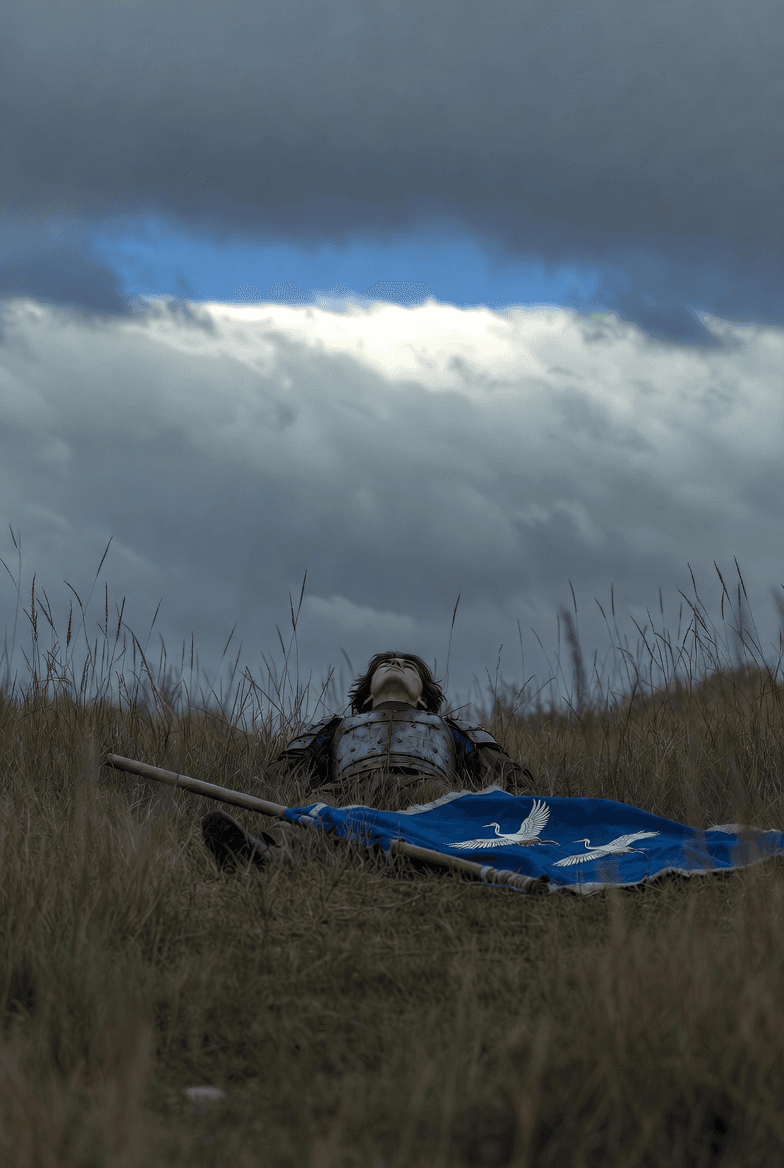
I lay upon this plain, watching the clouds
Mimic my thoughts, then melt and gather anew.
No hand may conjure this peace; it must be found.
So I held close its brief and fragile shape,
And watched a chilled sun hound the heart of night,
Till heaven turned to a lurid, wounded blue.
Far off within the recesses of my mind,
Emptiness is the master of a domain silent and still.
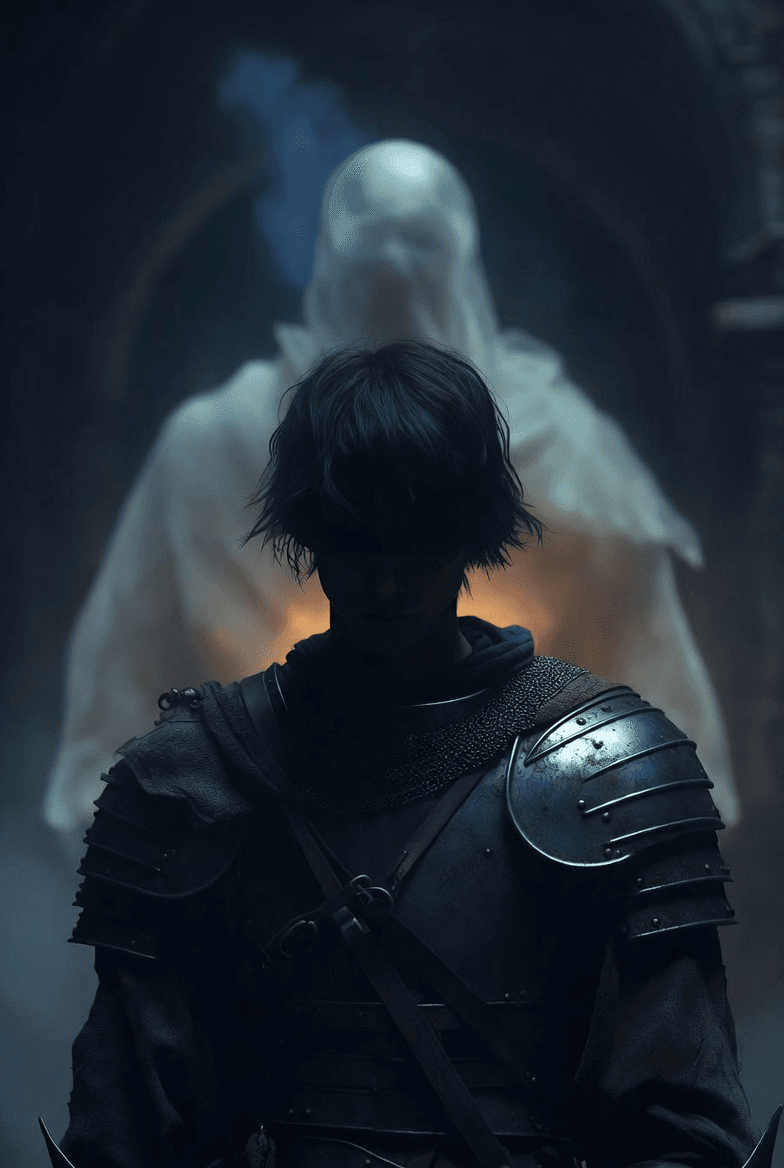
Thoughts filled the void, there rose the voice of my sire:
Father’s Doctrine
“War — Harbinger of Death — beckons us all
Irresistible, men will always heed its call.
For it comes silently, veiled by thin shroud,
And grips its beholder like a vice once found.
But what could you know of such calamity?
Infinite its desire, consuming all it invites
Though insatiable its appetite,
One claims its descendency
A brief respite from its mortal tendency.
Lady Peace — like a new summer’s sun,
Melts away its shackles of ice,
And provides refuge for acts never undone.
Men guard it well, for few will dare to trace
Its mother—war—and meet her iron face,
And what can you know of war? I knew it first;
I watched it quench its bloody thirst.
It is the realm of desolation—unyielding, stark;
It beckons the brave with whispers from the dark.
You have yet to feel death’s cold, enfolding hand,
Where hope turns from the hearts she cannot stand.
It seeps in bone, it settles, deep and sore,
And takes men long before their intended score.
Yet once, I fought to carve this peace you keep;
Remember: peace is earned with waking sleep.
You are the heir of desolation’s line;
So bask amid this quiet—though brief—and call it fine.
For men like us, such mercy comes but rare;
So take its warmth, yet keep your harness there.
There is a time for peace, a time for war;
Cling loose to peace—then muster evermore.
Lift high the name our fathers bore long before;
Stand fast, my son—-so it may live on, forevermore.”
The Speck, The Arrow
If only he were here now, not mere words,
Reverberating in my mind’s deep hollowed vault;
His utterance, my guide, I heeded him.
And so, I drank this ephemeral peace,
Aware how rare, how narrow its expanse.
The sun lit grey clouds, overcast and drear;
Then broke behind one thinning, drifting shroud,
And spilled a fiery rivulet of light
Across my gaze. I closed my eyes in awe.
Please never fade — oh, beautiful, beautiful quiet day.
I unclenched my eyes, the world’s colour set
To behold a sight I’d never seen in years.
What a peculiar discovery—look:
A faint black speck, suspended in the Sun.
I watched, as curiosity held me fast,
And wondered why, in all my years, I had missed
What now made plain, in the blindness of my gaze.
Until it came close enough to take
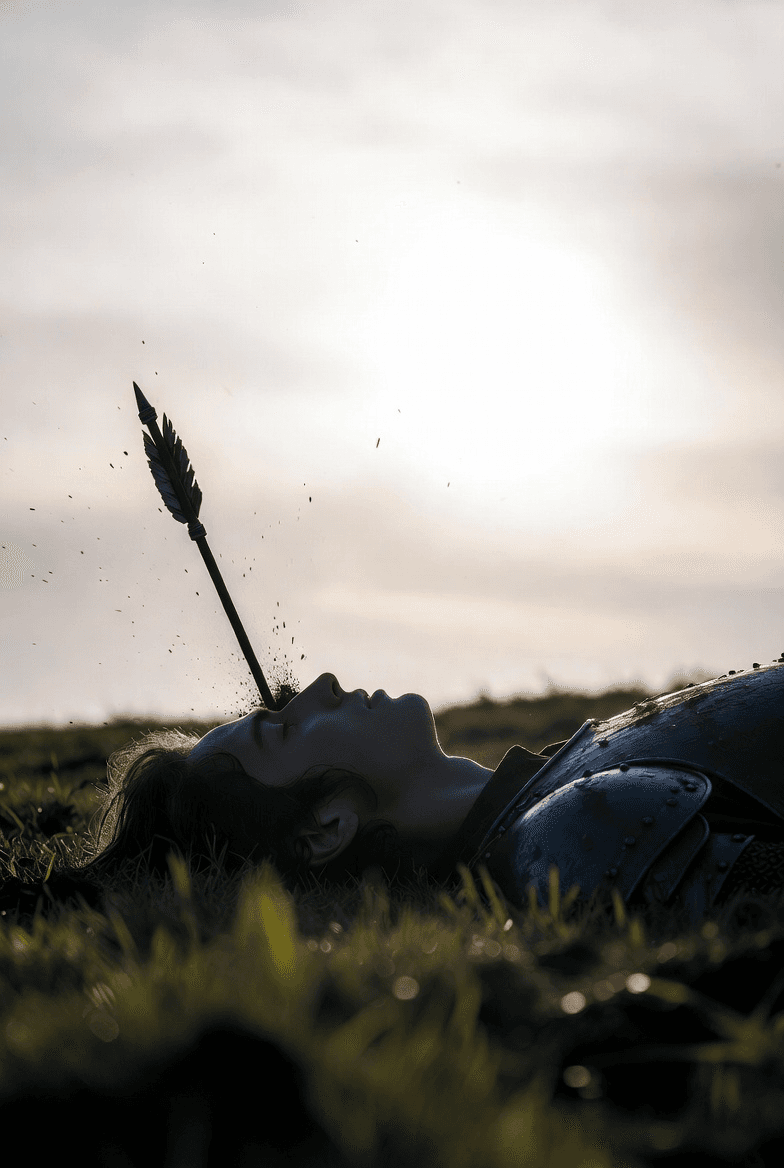
The sharpened silhouette of an arrow,
Planting itself in the earth beside my brow,
Whispering the wind’s song into my ear,
Indifferent to who might hear its music.
“A time for war …” my father’s whisper came,
A faint bellow under that overture.
Pertinacity took shape as human hands
As if they clasped my gorget hauling me
To stand again. And I felt my heart
Collapse down to my core—why now? Why now
Does courage flee this vanquished heart of mine?
Inwardly I cursed its untimely frailty;
Yet this scene I saw was scarcely tenable.
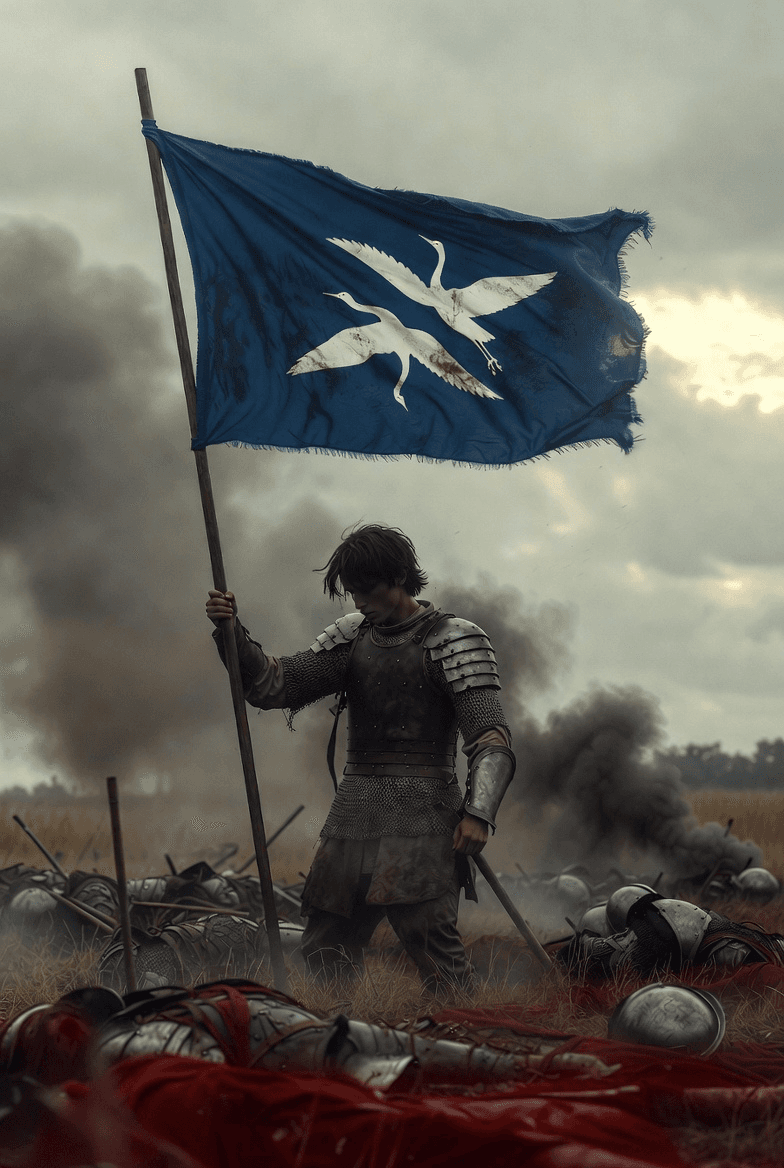
Revealed Slaughter
For I—who moments since drank blissful peace—
Lay in a meadow plagued by calamity,
Fortunate that my rest had been but brief;
For this was a final resting-place for most.
As the bodies of conscious creatures
Young men of dreams and promise—now lay hewn
Like cattle set for slaughter, by the craft
Of devious devices forged of their own kind.
That once-wonderous dawn of the sky had married
The crimson of the ground—till heaven’s blue
And lifeblood met, and mingled, and became one.
As the life-essence of a thousand men,
Once a flame and fuel for the living
Was now all but a visage of death; as the artist
Wields the brush to paint upon tapestry,
Gruesome warriors wielding sword and shield,
In smoke and cries, had stained that illustrious sky.
Begrudgingly I—reached into the plain
To pick from the earth our country’s fallen standard,
And steeled this wretched heart of mine—for now
Was not the hour for cowardice to breathe.
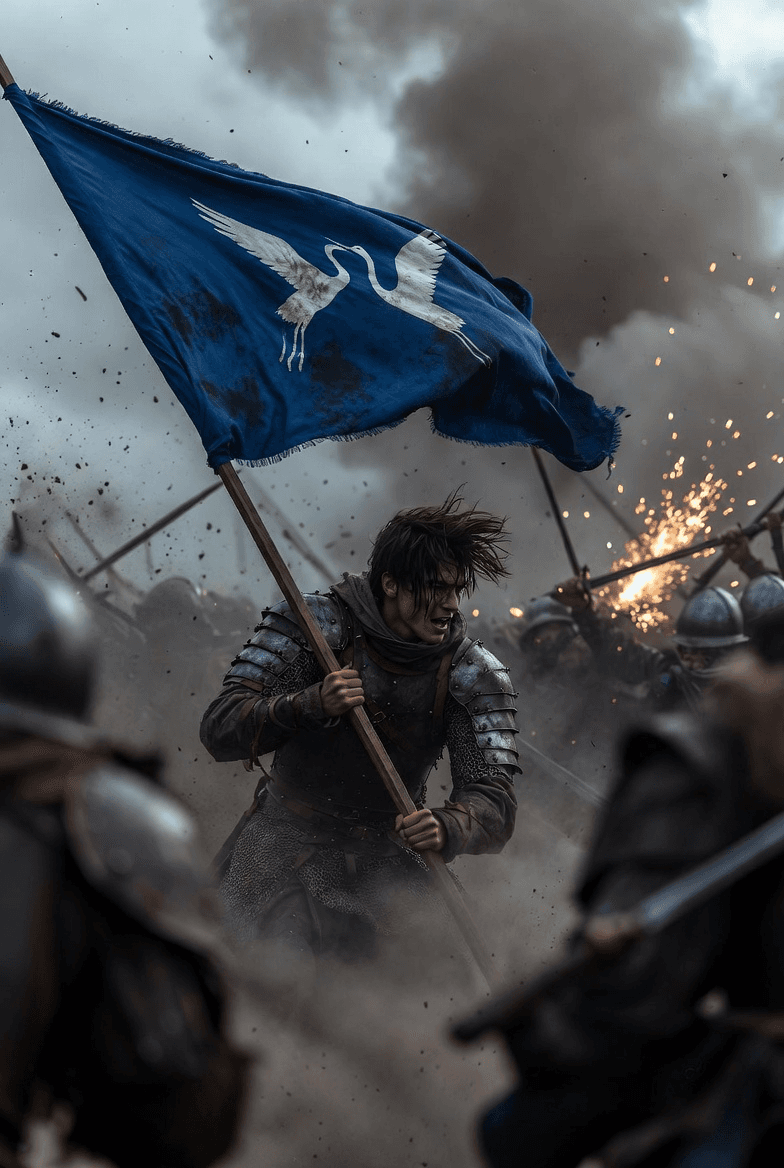
And so, I plunged once more into the fray,
This grand cacophony of violence
Bearing the standard of our forefathers —
Dragging my heavy feet, one after one,
Wearing a mask of dauntless on my face,
Urging men-at-arms on, suffering every inch.
Please, fade — oh, dreary, dreary desolate day,
The Standardbearer in the Press
One after one—a thousand strong—we moved;
We marched to meet a drum that bellowed loud.
We met our adversary, gave no quarter,
We fought upon the hilltop, fought the plain;
We fought upon the riverbed laid bare,
And fought on desecrated, broken earth.
Even I—the Standardbearer—joined the press,
And slew a foe with shuddering disregard.
Death’s icy grip, like iron in a vice,
Laid him to rest with comfort only steel—
The edge of my blade flaying through his breast.
His heart bled out where once a field was green;
This graveyard swallowed all his mind in full.
I shivered, knowing I could deal with such horror.
Yet clamouring of steel and cries swept on,
And drowned out reason—so I became dread’s hand,
The deliverance of terror, and its thrall.
And though we slew so many in that churn
I could not shake the sense that the tide turned.
I read it in my brethren’s hollowed eyes,
And saw the fire-bellied in their souls diminish.
It would not be long before mine, too, went out.
For thick had grown the air with iron’s breath,
And every gust bore ash and guttural prayer.
The heavens, once a cobalt sanctuary,
Now watched like tempered steel—unblinking, cold,
As if the Gods themselves held back their hands
To see what Men would make of Men, again.
Treason of the Heart
A horn cried out — then choked upon the din;
Commands were flung like pebbles in a storm.
I saw our line, a wall of stitched resolve,
Unravel at the seams of weary limbs,
And in the eyes of brethren — hollowed out —
Did Hope, that timid maiden, turn away.
O father — have you foreseen this very turn?
“Cling loosely to the former,” you once said,
“And muster for the latter.” Look! I mustered —
Yet muster is but posture without flame.
For courage, when it falters in the chest,
Is a sword that breaks — and hands that shake.
Then came a hush — not peace, but breathless dread,
That dreadful stillness war affords at times,
When each man hears at last his private heart,
And finds it pounding treason through his ribs.
My fingers tightened on our forebears’ pole,
As if the wood itself could anchor me.
A sudden hiss — the whisper of the wind
Recalled that omen arrow at my brow;
And as if Fate had practiced once before,
Another darkness leapt from the distant sky.
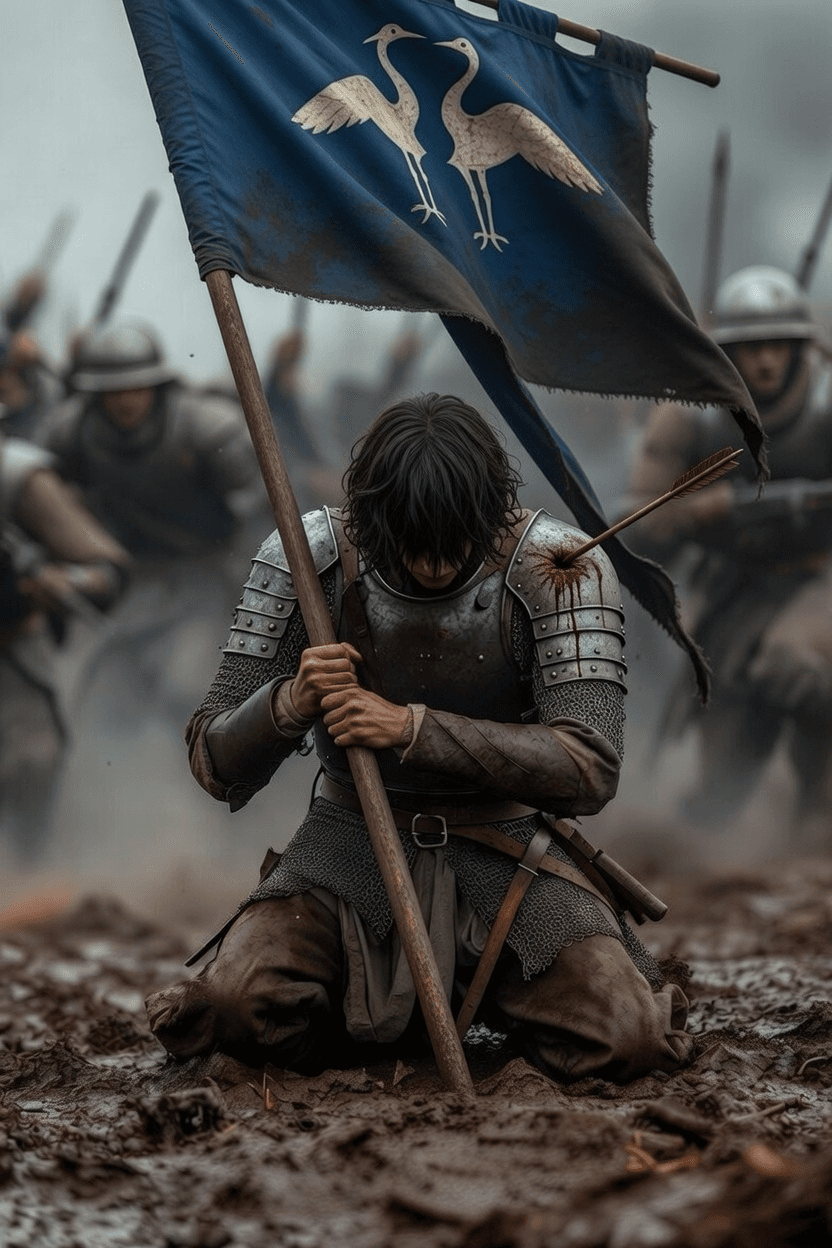
It kissed my shoulder — buried to the flesh —
And fire poured through sinew, bright and raw.
I staggered; earth rose up to meet my knee.
The standard swayed — a mighty, mortal thing,
No longer symbol only, but a weight,
A living burden forged of a thousand names.
I tasted copper; heard the river’s roar
Though none was near — but blood within my ears.
Why now, does courage flee this vanquished heart?
Why now, when all my father’s words stand near?
I sought to stand — and yet my heel betrayed,
As if the soil itself, grown fat with death,
Would keep what it had taken, keep me too,
And claim my oath along with broken men.
In that one instant — shame, like winter, came.
Not fear of dying — no, that fear was old —
But fear of failing what my sire had sown;
Of living half a breath as less than man.
For what is war, if not a ruthless judge,
That measures all by what they’ve done when torn?
And there, amid the crush of fleeing forms,
I felt the pull — that ancient, sinful pull —
To turn from banners, turn from bleeding cries,
To trade the legacy of blood and bone
For one more heartbeat’s counterfeit of peace.
Ah, peace — the off-spring of a brutal womb —
How quickly it becomes counterfeit in war.
My arms grew slack. The standard dipped and leaned.
The Nephrite-Eyed Verdict
The sigil shuddered — not from wind, but fragility,
And as it bowed, as if in bleak farewell,
A shadow crossed my sight — a man drew near,
Not borne by panic, not by desperate haste,
But moving like a verdict through the smoke.
Into this man’s nephrite eyes — violent, gruesome —
Did I find security entwined with spite;
A bitter sanctum in a bitter world,
As though malignity could mask the truth
That he, alone, still carried living flame
Where ours had drowned — in fear and mud.
Could this be the final bastion of the hopes of a people?
Amid a leer which spoke the tongue of carnage,
I — shamefully — found solace in such ruin;
For there are moments desolation births
A hideous kind of comfort in the strong:
A promise that not all shall cower and crack.
As if distilled into this man by Gods,
Did I, for the first time upon this day,
Feel but a sliver of Hope burn anew?
Not gentle Hope of meadow, cloud, and calm —
But Hope made hard — a flint within the fist,
That strikes its light by violence, if it must.
He did not speak — yet spoke his gaze enough,
Piercing through marrow, measuring my soul.
And I, who bore the standard of my sires,
Felt all my fathers standing at my back —
Not to condemn, but to command: release.
So relinquished did I the forebears’ standard,
Not cast aside in cowardice alone,
But offered — like a torch to steadier hands —
That this man should shoulder what I could not.
My grip unknotted; timber left my palm.
And in that letting-go I understood:
Some legacies are saved by yielding them.
He took the pole as if it weighed him naught.
Then with one hand he braced me — kept me from
The greedy mouth of soil that yearned for more.
And gently — oh, impossibly — he laid
My failing form upon torn, trampled earth,
As one might lay a brother down to sleep.
Above, the Sun began its weary fall,
And all the day’s red sins climbed up the clouds.
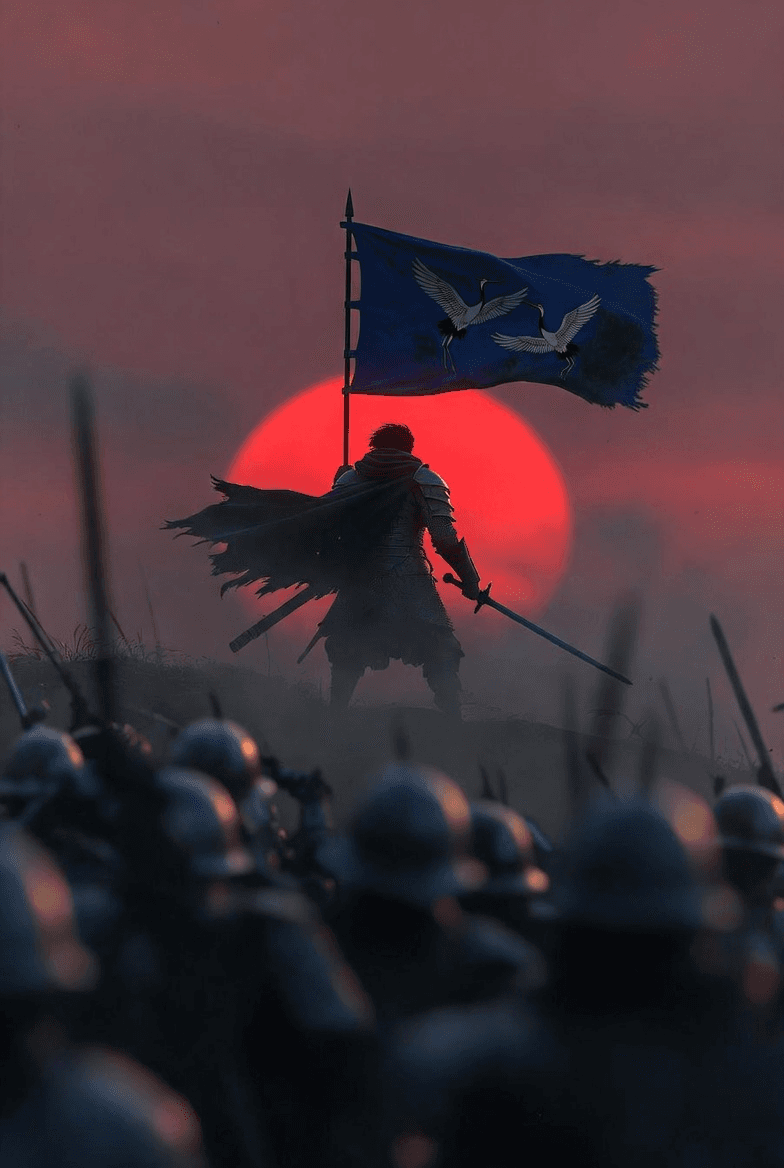
I watched this man — emerald-eyed, unshaken —
Bear the standard of our very nation
Unto the ridge beyond; the blood-red sun
A crown behind his frame, his cloak in wind,
A single figure cut against the blaze.
And into the fray — one against many —
Did the sigil of our forefathers fly,
As if the cloth remembered every oath
And found again its purpose in the air.
He plunged where steel converged like starving jaws,
And still the banner did not bend or die.
Then — like thunder answering distant storm —
A thousand more rose up behind that sign.
Not summoned by a lord’s thin-lunged command,
But dragged by image — by that savage grace
Of one man standing when the rest would break.
Inspired, they surged; the valley shook with feet.
I, however, lay once more in that meadow,
Despite a longing burning to arise.
The blood that once coursed these veins was now
Drunk deep by earth — as if the plain itself
Desired my life to feed its crimson art.
Yet fear nor bliss set in — nor pain nor grief —
Not even sound itself; silence my companion.
And as cold death drew spirit from my flesh,
I felt again that hollow in my mind
Where Father’s voice had dwelt these many years.
No longer echo — no longer distant counsel —
But presence, warm as hearth beyond the dark,
Summoning me home from fields of bone.
So, in the last dim margin of my sight,
I held that image — banner, cloak, and ridge —
As if to name it was to make it true:
That legacy may live though I depart,
That courage may be carried when I fall,
That peace may come — not found, but dearly bought.
Please never fade — oh, beautiful, beautiful immaculate day.